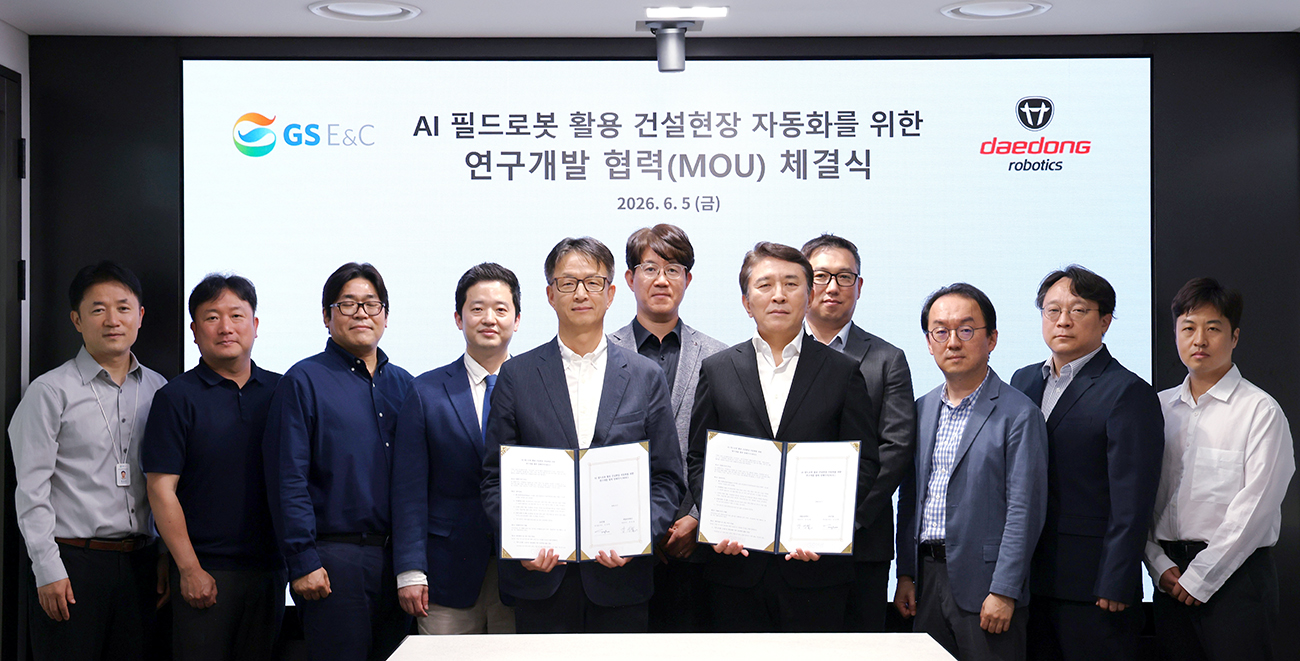
Daedong Robotics Signs MOU with GS E&C on AI Field Robot R&D
- Daedong Robotics and GS E&C will jointly research and develop construction site automation and smart construction technologies.
- AI-powered robots with autonomous driving capabilities will be demonstrated and commercialized for material transport, repetitive work and other construction site tasks.
- Daedong Robotics is expanding into manufacturing, construction, defense and other sectors, drawing on core robotics technologies for unstructured environments.
Daedong Robotics is extending the reach of its AI field robots to construction sites.
Daedong Robotics (Co-CEOs Won Yu-Hyun and Kang Sung-chul), Daedong Group’s AI robotics specialist affiliate, announced on June 8, 2026, that it had signed a memorandum of understanding (MOU) with GS E&C on joint research and development in construction site automation and smart construction technologies.
The agreement focuses on establishing a framework for collaboration on AI field robot-based smart construction technologies at construction sites and developing the related market. The two companies will work closely in three areas: assessing the use of existing mass-produced AI field robots at construction sites; collaborating on smart construction operations and new technologies; and jointly researching and developing robots tailored to construction sites and conducting proof-of-concept (PoC) testing.
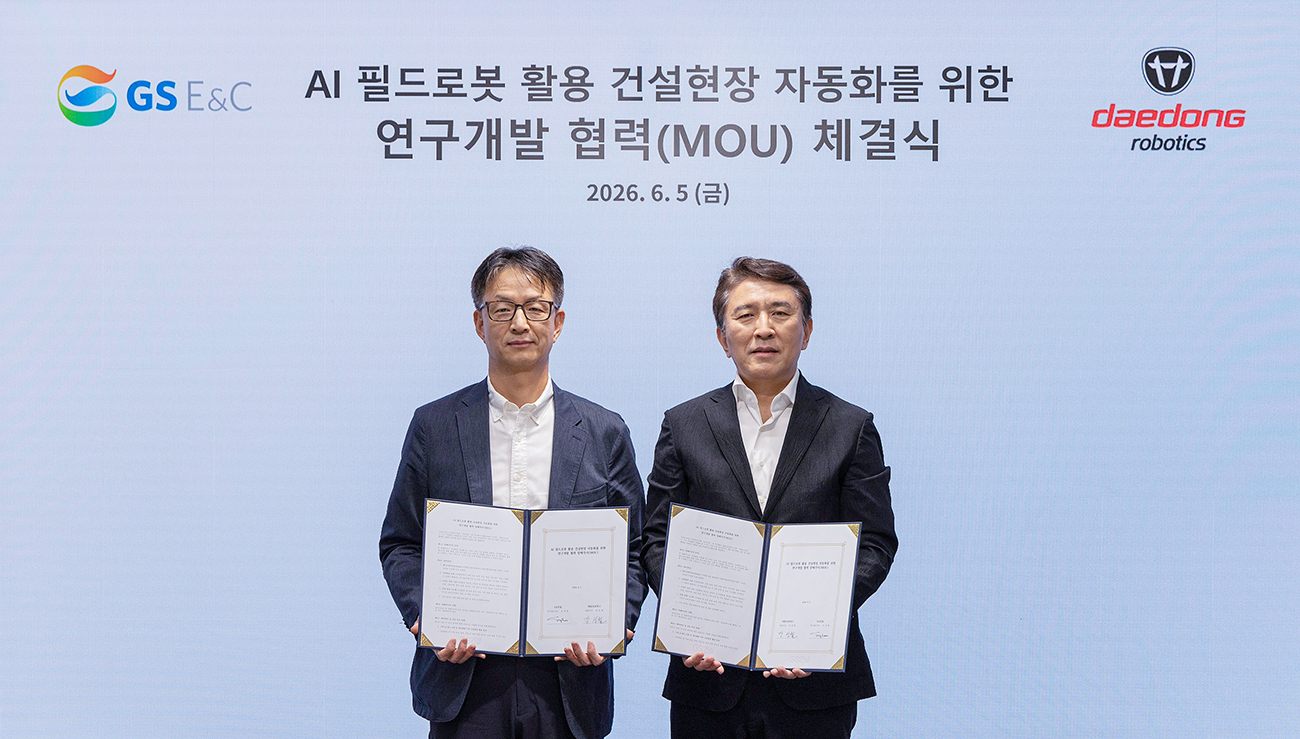
Daedong Robotics will use its robot platform with autonomous driving capabilities to design robots optimized for construction sites and advance the underlying technologies. It will focus its technical capabilities on everything from assessing whether existing mass-produced products can be deployed on site to developing and demonstrating new robots. GS E&C will provide construction sites for demonstrations and identify requirements from site operators’ perspectives to jointly shape the direction of technology development. It will also actively collaborate on technology validation and commercialization.
Since its establishment in October 2024, Daedong Robotics has rapidly advanced its technological capabilities and expanded its business, launching an agricultural transport robot in early 2025 and subsequently securing Korea’s first certification for an autonomous agricultural utility vehicle. It currently has three core technologies tailored to unstructured environments, including indoor and outdoor autonomous driving, vision AI- and multi-sensor-based 3D spatial perception, LLM-based voice interfaces, and multi-robot operations, monitoring and control. Drawing on these technologies, it is preparing to launch multipurpose agricultural robots for tasks such as mowing and crop protection.
Beyond agriculture, its business is rapidly expanding into manufacturing, construction, defense and other sectors. Having supplied ore-spill cleanup robots and in-house logistics robots, the company is also developing robots for construction sites, including construction material transport robots. It plans to step up the development of robots for industrial applications, including factories and construction sites, and transition to a data-driven robotics-as-a-service (RaaS) platform by 2030.
According to market research firm Mordor Intelligence, the global construction robot market was valued at approximately USD 442 million (approximately KRW 640 billion) in 2025 and is projected to grow at a compound annual rate of 15.5% to reach USD 909 million by 2030. Demand for construction automation is rising rapidly as labor shortages, tighter safety regulations and advances in smart construction technologies converge. Against this backdrop, AI-powered robots with autonomous driving capabilities are drawing attention for their role in key on-site processes, such as material transport and repetitive work.