Daedong Brings Physical AI to the Factory Floor, Accelerating Manufacturing AX at Its Daegu Plant
-. Four manufacturing AX strategies will be implemented through 2029 to strengthen global manufacturing competitiveness with flexible production and precise quality control.
-. AI and robotics will be applied to 15 key processes to automate repetitive and less desirable tasks and improve productivity and quality.
-. A factory operating system will be built to link production, quality and logistics data and advance AI-driven production planning and quality control.
-. Tractor production capacity is expected to increase by 67% and machine-body painting capacity by 80%, while painting productivity is expected to improve by 17%.
Daedong (Co-CEOs Kim Jun-Sik and Won Yu-Hyun), a leader in future agriculture, is stepping up manufacturing AI transformation (AX) by applying AI, robotics and data on the factory floor, building on its agricultural AX initiatives involving AI tractors and agricultural robots. The company plans to transform its Daegu plant into a physical AI-based production system for the future to improve productivity, quality and responsiveness to market needs.
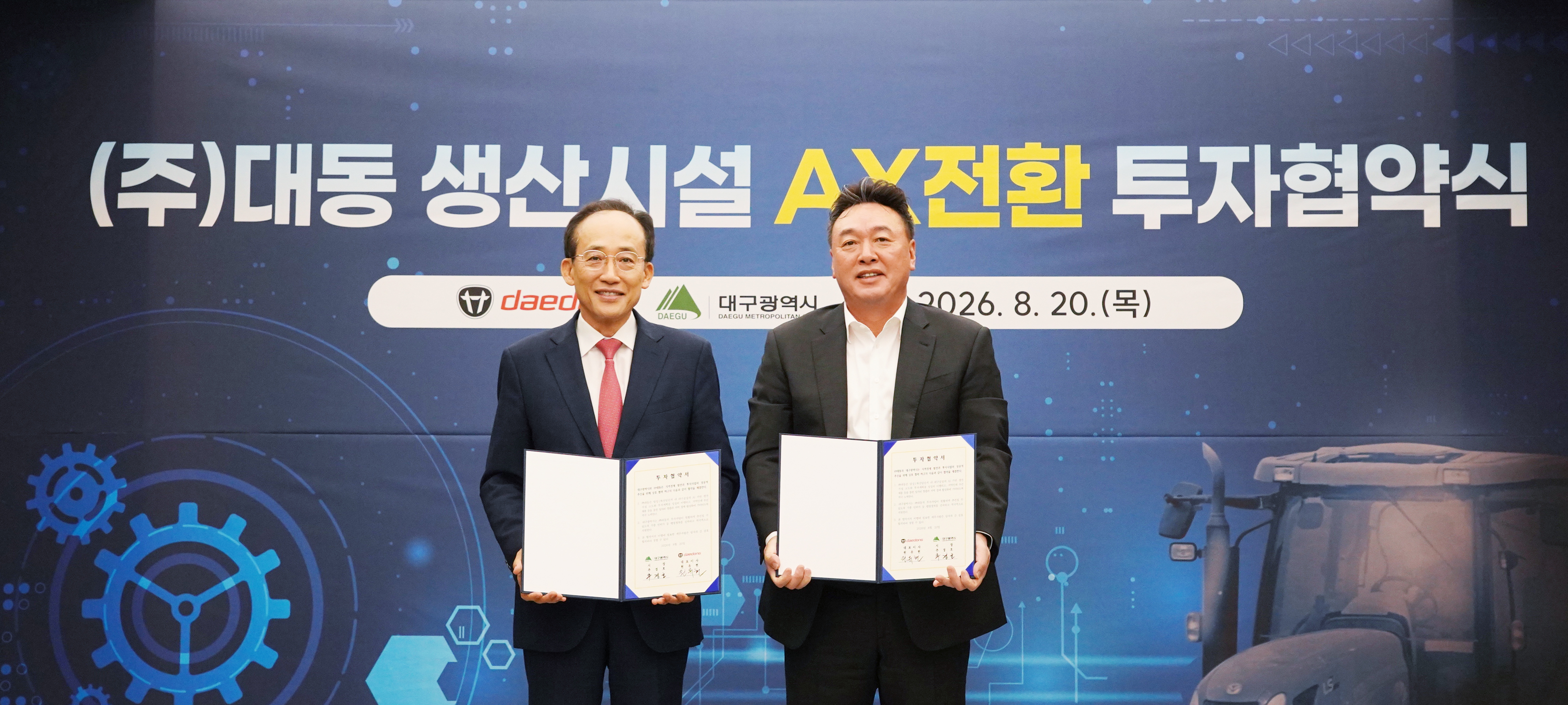
Daedong announced on August 20, 2026, that it had signed a memorandum of understanding (MOU) with Daegu Metropolitan City on reshoring and investment in factory AX. Under its ‘Daegu Plant Manufacturing AX Master Plan’, currently being developed, Daedong is setting out four key strategies: restructuring production and logistics; establishing new AX production lines; converting existing production lines to AX; and building a data- and AI-driven factory operating system. It will pursue these initiatives in parallel through 2029, following the schedule for each initiative.
The core of this manufacturing AX initiative is to automate repetitive, physically demanding tasks using AI and robotics, while linking production, quality and logistics data for AI analysis to improve productivity, quality and manufacturing flexibility. The Daegu plant currently produces tractors in about 200 configurations for export to about 70 countries. A flexible production system is becoming increasingly important as products become larger and more technologically advanced and global markets diversify. Daedong is expanding its global agricultural machinery business and future businesses, including AI agricultural machinery and agricultural robots, with a target of KRW 3.59 trillion in consolidated revenue by 2030. The company therefore sees upgrading its production system to support these businesses as an essential foundation for medium- to long-term growth.
Daedong will gradually introduce physical AI technologies, in which AI and robots perform real-world tasks, across 15 key processes on its new AX production lines. AI will optimize production sequencing and process operations, while autonomous mobile robots (AMRs) and robotic equipment will automate material supply, engine and transmission assembly, and the transport and installation of cabs and tires. The company also plans to deploy 12 robots in the painting process to improve work efficiency and quality consistency while enhancing the working environment.
Quality control will also be enhanced through AI and data. Vision inspection using cameras and AI will detect quality issues such as incomplete assembly and oil leaks, while automatic checks at the final stage of the production line will assess the software and system status of completed agricultural machinery. Daedong will also establish an AI-based quality control system that links inspection results with production history data to analyze the causes of defects and predict their likelihood.
Factory operations will also shift to a data- and AI-driven approach. Production, logistics and quality data will be integrated, and AI agents will be introduced in stages across procurement, materials management, production and quality control to support tasks such as production planning and quality control. Daedong plans to develop an operating system in which a factory operations center provides integrated, real-time oversight of production, quality and equipment status across the plant. The system will use accumulated data to optimize production planning and predict equipment anomalies before they occur.
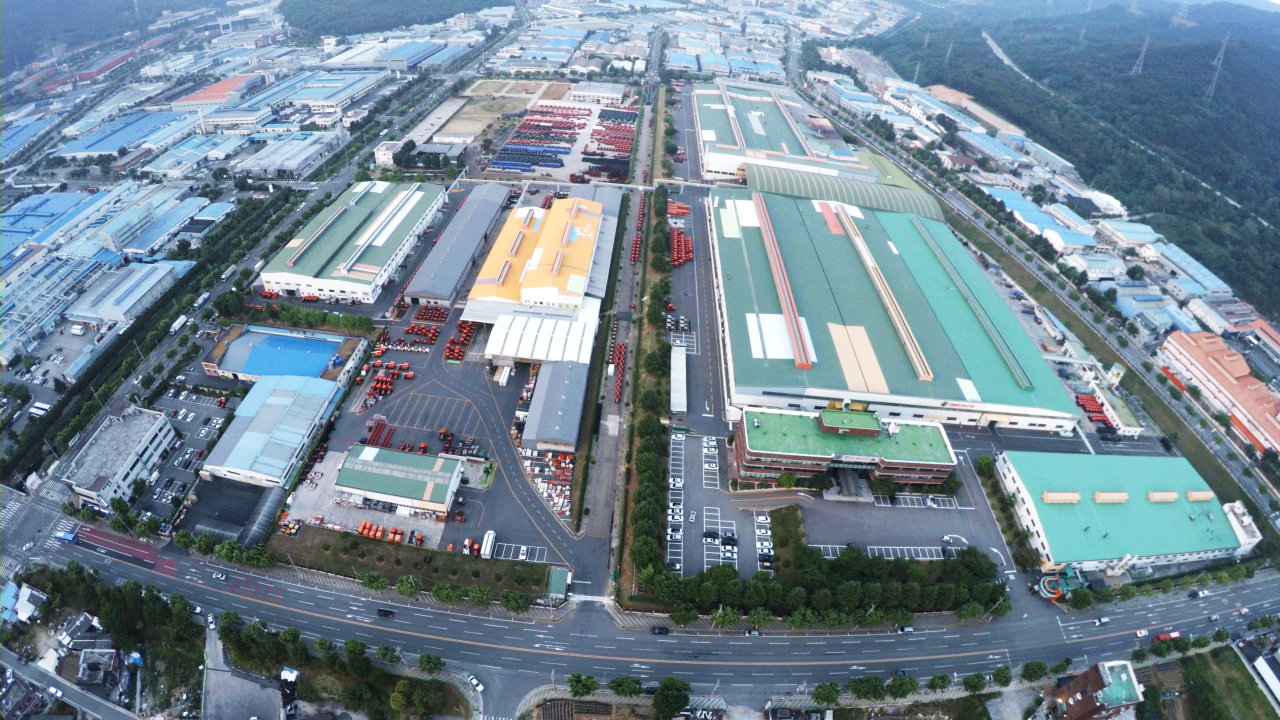
Daedong will also restructure production and logistics at its existing plant. It plans to simplify production lines and logistics routes and optimize material delivery methods—including AMRs, tugger trains and electric forklifts—according to material characteristics. The aim is to establish a high-mix, low-volume production system that can respond quickly to changes in product specifications and production plans.
The restructuring of production and logistics and the introduction of AI and robotics are expected to expand production capacity and improve process efficiency. Regular tractor production capacity will increase by about 67%, from 21,000 to 35,000 units annually, while machine-body painting capacity will rise by 80%, from 35,000 to 63,000 units annually. Work time per unit will fall from 2.3 to 1.9 minutes, with painting productivity expected to improve by about 17%.